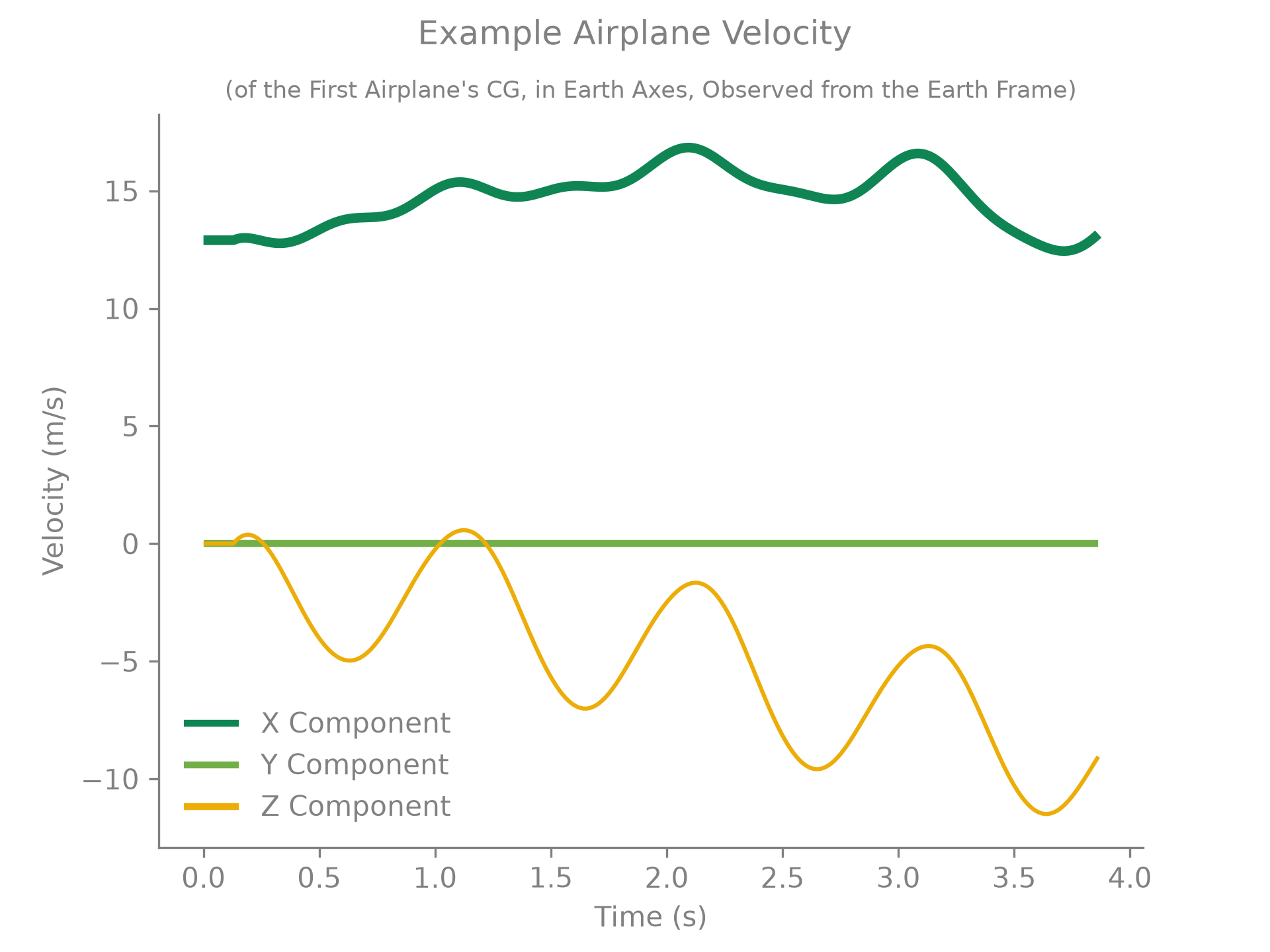
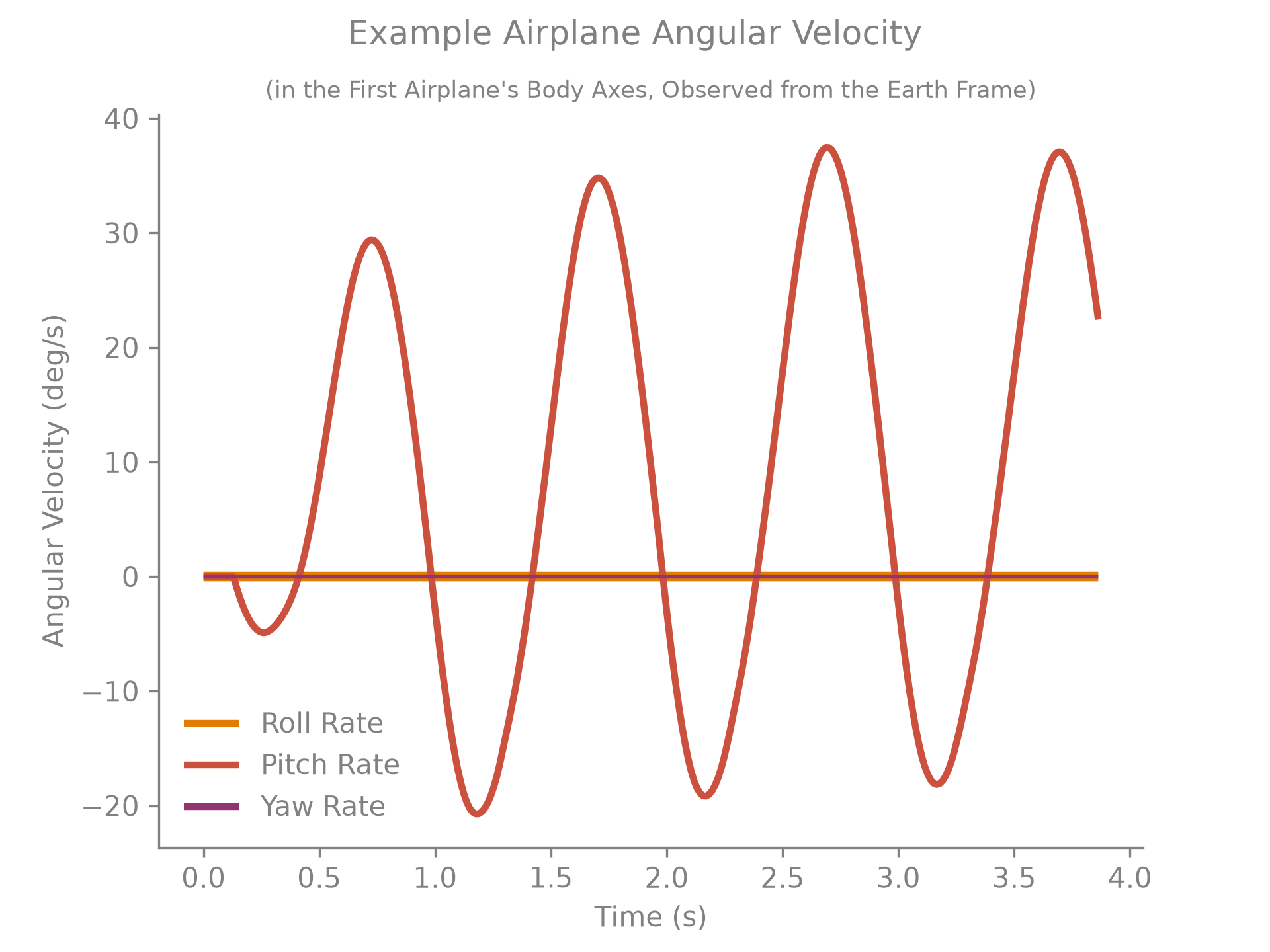
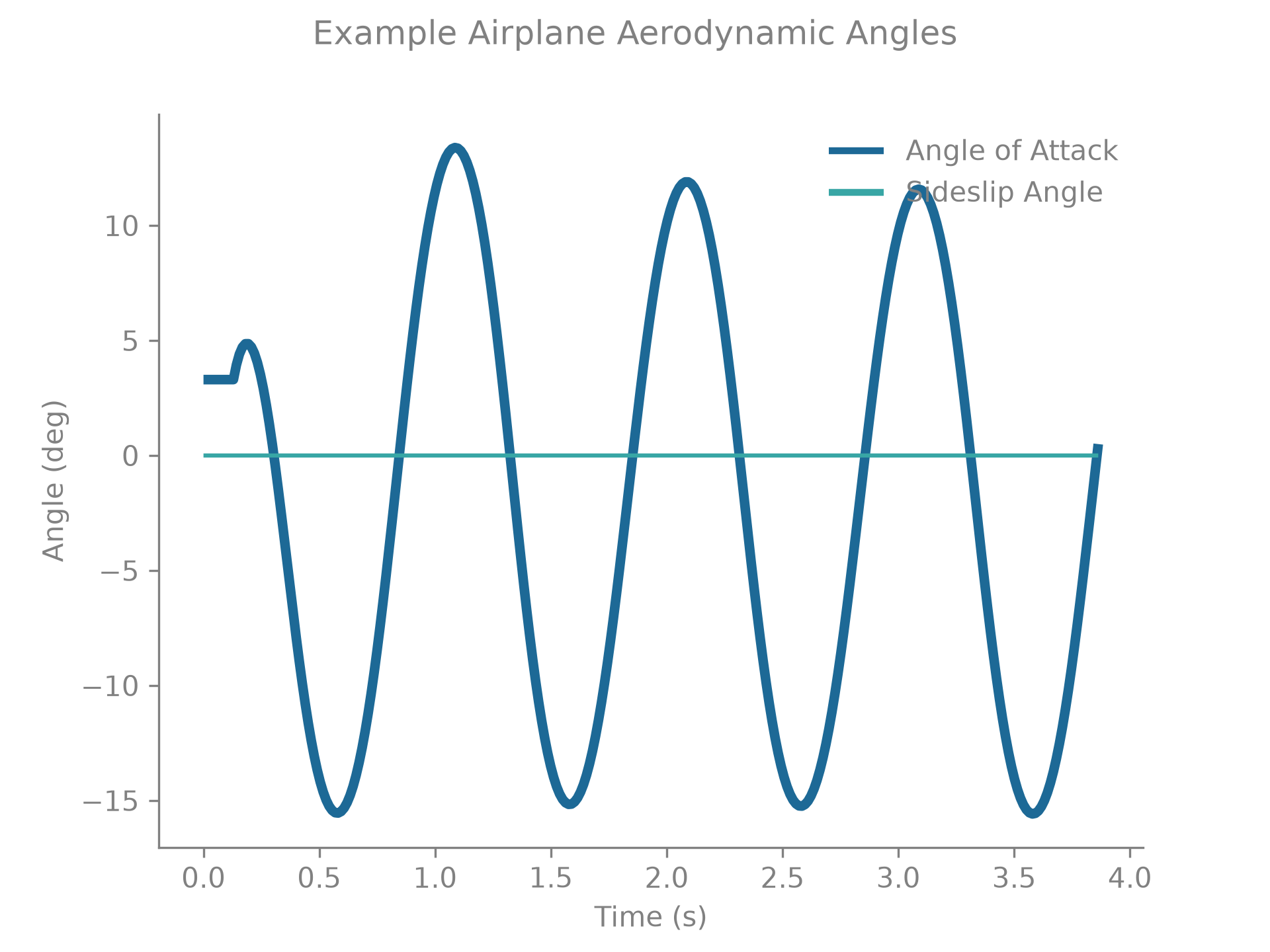
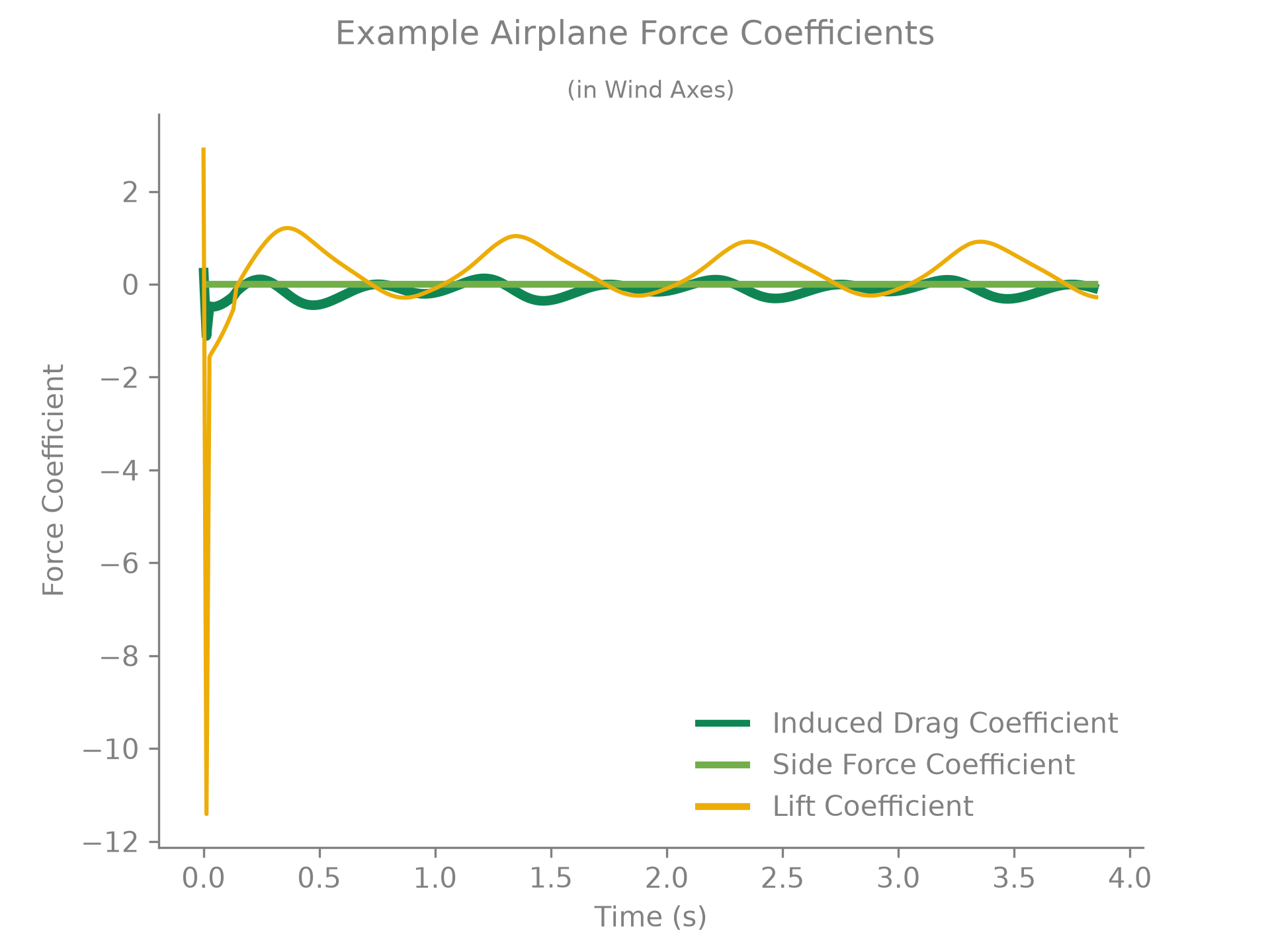
"""Demonstrates running Ptera Software's FreeFlightUnsteadyRingVortexLatticeMethodSolver
with a flapping-wing configuration.

The main wing flaps symmetrically while the unsteady aerodynamics are coupled to
MuJoCo's rigid body dynamics, so the airplane flies a free six-degree-of-freedom
trajectory through the scene under the loads produced by its own flapping motion.

The script will likely take several minutes to run, and will log simulation progress and
results in a log file.
"""

import logging

# First, import the software's main package. Note that if you wished to import this
# software into another package, you would first install it by running "pip install
# pterasoftware" in your terminal.
import pterasoftware as ps

# Configure logging to write info level messages to a file. To display log messages on
# the console alongside progress bars instead, omit the handler argument.
ps.set_up_logging(level="Info", handler=logging.FileHandler("example_solver.log"))

# Create an Airplane with our custom geometry. I am going to declare every parameter for
# Airplane, even though most of them have usable default values. This is for educational
# purposes, but keep in mind that it makes the code much longer than it needs to be. For
# details about each parameter, read the detailed class docstring. The same caveats
# apply to the other classes, methods, and functions I call in this script.
#
# This is a flapping-wing demonstration airframe: a cambered main wing that flaps
# symmetrically (defined further below, a 15 degree amplitude at 1 Hz) plus a tail.
# Unlike the glider example, this airframe is not tuned for static stability or trim. It
# exists to exercise the strongly coupled free-flight solver under the large,
# oscillatory loads that flapping produces, so the trajectory is a driven flapping
# flight rather than a settled equilibrium.
example_airplane = ps.geometry.airplane.Airplane(
    wings=[
        ps.geometry.wing.Wing(
            wing_cross_sections=[
                ps.geometry.wing_cross_section.WingCrossSection(
                    num_spanwise_panels=8,
                    chord=1.75,
                    Lp_Wcsp_Lpp=(0.0, 0.0, 0.0),
                    angles_Wcsp_to_Wcs_ixyz=(0.0, 0.0, 0.0),
                    control_surface_symmetry_type="symmetric",
                    control_surface_hinge_point=0.75,
                    control_surface_deflection=0.0,
                    spanwise_spacing="cosine",
                    airfoil=ps.geometry.airfoil.Airfoil(
                        name="naca2412",
                        outline_A_lp=None,
                        resample=True,
                        n_points_per_side=400,
                    ),
                ),
                ps.geometry.wing_cross_section.WingCrossSection(
                    num_spanwise_panels=None,
                    chord=1.5,
                    Lp_Wcsp_Lpp=(0.75, 6.0, 1.0),
                    angles_Wcsp_to_Wcs_ixyz=(0.0, 5.0, 0.0),
                    control_surface_symmetry_type="symmetric",
                    control_surface_hinge_point=0.75,
                    control_surface_deflection=0.0,
                    spanwise_spacing=None,
                    airfoil=ps.geometry.airfoil.Airfoil(
                        name="naca2412",
                        outline_A_lp=None,
                        resample=True,
                        n_points_per_side=400,
                    ),
                ),
            ],
            name="Main Wing",
            Ler_Gs_Cgs=(0.0, 0.5, 0.0),
            angles_Gs_to_Wn_ixyz=(0.0, 0.0, 0.0),
            symmetric=True,
            mirror_only=False,
            symmetryNormal_G=(0.0, 1.0, 0.0),
            symmetryPoint_G_Cg=(0.0, 0.0, 0.0),
            num_chordwise_panels=6,
            chordwise_spacing="uniform",
        ),
        ps.geometry.wing.Wing(
            wing_cross_sections=[
                ps.geometry.wing_cross_section.WingCrossSection(
                    num_spanwise_panels=8,
                    chord=1.5,
                    Lp_Wcsp_Lpp=(0.0, 0.0, 0.0),
                    angles_Wcsp_to_Wcs_ixyz=(0.0, 0.0, 0.0),
                    control_surface_symmetry_type="symmetric",
                    control_surface_hinge_point=0.75,
                    control_surface_deflection=0.0,
                    spanwise_spacing="uniform",
                    airfoil=ps.geometry.airfoil.Airfoil(
                        name="naca0012",
                        outline_A_lp=None,
                        resample=True,
                        n_points_per_side=400,
                    ),
                ),
                ps.geometry.wing_cross_section.WingCrossSection(
                    num_spanwise_panels=None,
                    chord=1.0,
                    Lp_Wcsp_Lpp=(0.5, 2.0, 1.0),
                    angles_Wcsp_to_Wcs_ixyz=(0.0, 0.0, 0.0),
                    control_surface_symmetry_type="symmetric",
                    control_surface_hinge_point=0.75,
                    control_surface_deflection=0.0,
                    spanwise_spacing=None,
                    airfoil=ps.geometry.airfoil.Airfoil(
                        name="naca0012",
                        outline_A_lp=None,
                        resample=True,
                        n_points_per_side=400,
                    ),
                ),
            ],
            name="V-Tail",
            Ler_Gs_Cgs=(5.0, 0.0, 0.0),
            angles_Gs_to_Wn_ixyz=(0.0, -5.0, 0.0),
            symmetric=True,
            mirror_only=False,
            symmetryNormal_G=(0.0, 1.0, 0.0),
            symmetryPoint_G_Cg=(0.0, 0.0, 0.0),
            num_chordwise_panels=6,
            chordwise_spacing="uniform",
        ),
    ],
    name="Example Airplane",
    Cg_GP1_CgP1=(0.0, 0.0, 0.0),
    weight=420.0,
    s_ref=None,
    c_ref=None,
    b_ref=None,
)

# Now define the main wing's root and tip WingCrossSections' WingCrossSectionMovements.
main_wing_root_wing_cross_section_movement = (
    ps.movements.wing_cross_section_movement.WingCrossSectionMovement(
        base_wing_cross_section=example_airplane.wings[0].wing_cross_sections[0],
        ampLp_Wcsp_Lpp=(0.0, 0.0, 0.0),
        periodLp_Wcsp_Lpp=(0.0, 0.0, 0.0),
        spacingLp_Wcsp_Lpp=("sine", "sine", "sine"),
        phaseLp_Wcsp_Lpp=(0.0, 0.0, 0.0),
        ampAngles_Wcsp_to_Wcs_ixyz=(0.0, 0.0, 0.0),
        periodAngles_Wcsp_to_Wcs_ixyz=(0.0, 0.0, 0.0),
        spacingAngles_Wcsp_to_Wcs_ixyz=("sine", "sine", "sine"),
        phaseAngles_Wcsp_to_Wcs_ixyz=(0.0, 0.0, 0.0),
    )
)
main_wing_tip_wing_cross_section_movement = (
    ps.movements.wing_cross_section_movement.WingCrossSectionMovement(
        base_wing_cross_section=example_airplane.wings[0].wing_cross_sections[1],
        ampLp_Wcsp_Lpp=(0.0, 0.0, 0.0),
        periodLp_Wcsp_Lpp=(0.0, 0.0, 0.0),
        spacingLp_Wcsp_Lpp=("sine", "sine", "sine"),
        phaseLp_Wcsp_Lpp=(0.0, 0.0, 0.0),
        ampAngles_Wcsp_to_Wcs_ixyz=(0.0, 0.0, 0.0),
        periodAngles_Wcsp_to_Wcs_ixyz=(0.0, 0.0, 0.0),
        spacingAngles_Wcsp_to_Wcs_ixyz=("sine", "sine", "sine"),
        phaseAngles_Wcsp_to_Wcs_ixyz=(0.0, 0.0, 0.0),
    )
)

# The main Wing was defined to have symmetric=True, mirror_only=False, and with a
# symmetry plane offset non coincident with the Wing's axes yz plane. Therefore, that
# Wing had type 5 symmetry (see the Wing class documentation for more details on
# symmetry types). Therefore, it was actually split into two Wings, the with the second
# Wing being a reflected version of the first. Therefore, we need to define a
# WingMovement for this reflected Wing. To start, we'll first define the reflected main
# wing's root and tip WingCrossSections' WingCrossSectionMovements.
reflected_main_wing_root_wing_cross_section_movement = (
    ps.movements.wing_cross_section_movement.WingCrossSectionMovement(
        base_wing_cross_section=example_airplane.wings[1].wing_cross_sections[0],
        ampLp_Wcsp_Lpp=(0.0, 0.0, 0.0),
        periodLp_Wcsp_Lpp=(0.0, 0.0, 0.0),
        spacingLp_Wcsp_Lpp=("sine", "sine", "sine"),
        phaseLp_Wcsp_Lpp=(0.0, 0.0, 0.0),
        ampAngles_Wcsp_to_Wcs_ixyz=(0.0, 0.0, 0.0),
        periodAngles_Wcsp_to_Wcs_ixyz=(0.0, 0.0, 0.0),
        spacingAngles_Wcsp_to_Wcs_ixyz=("sine", "sine", "sine"),
        phaseAngles_Wcsp_to_Wcs_ixyz=(0.0, 0.0, 0.0),
    )
)
reflected_main_wing_tip_wing_cross_section_movement = (
    ps.movements.wing_cross_section_movement.WingCrossSectionMovement(
        base_wing_cross_section=example_airplane.wings[1].wing_cross_sections[1],
        ampLp_Wcsp_Lpp=(0.0, 0.0, 0.0),
        periodLp_Wcsp_Lpp=(0.0, 0.0, 0.0),
        spacingLp_Wcsp_Lpp=("sine", "sine", "sine"),
        phaseLp_Wcsp_Lpp=(0.0, 0.0, 0.0),
        ampAngles_Wcsp_to_Wcs_ixyz=(0.0, 0.0, 0.0),
        periodAngles_Wcsp_to_Wcs_ixyz=(0.0, 0.0, 0.0),
        spacingAngles_Wcsp_to_Wcs_ixyz=("sine", "sine", "sine"),
        phaseAngles_Wcsp_to_Wcs_ixyz=(0.0, 0.0, 0.0),
    )
)

# Now define the V-tail's root and tip WingCrossSections' WingCrossSectionMovements.
v_tail_root_wing_cross_section_movement = (
    ps.movements.wing_cross_section_movement.WingCrossSectionMovement(
        base_wing_cross_section=example_airplane.wings[2].wing_cross_sections[0],
        ampLp_Wcsp_Lpp=(0.0, 0.0, 0.0),
        periodLp_Wcsp_Lpp=(0.0, 0.0, 0.0),
        spacingLp_Wcsp_Lpp=("sine", "sine", "sine"),
        phaseLp_Wcsp_Lpp=(0.0, 0.0, 0.0),
        ampAngles_Wcsp_to_Wcs_ixyz=(0.0, 0.0, 0.0),
        periodAngles_Wcsp_to_Wcs_ixyz=(0.0, 0.0, 0.0),
        spacingAngles_Wcsp_to_Wcs_ixyz=("sine", "sine", "sine"),
        phaseAngles_Wcsp_to_Wcs_ixyz=(0.0, 0.0, 0.0),
    )
)
v_tail_tip_wing_cross_section_movement = (
    ps.movements.wing_cross_section_movement.WingCrossSectionMovement(
        base_wing_cross_section=example_airplane.wings[2].wing_cross_sections[1],
        ampLp_Wcsp_Lpp=(0.0, 0.0, 0.0),
        periodLp_Wcsp_Lpp=(0.0, 0.0, 0.0),
        spacingLp_Wcsp_Lpp=("sine", "sine", "sine"),
        phaseLp_Wcsp_Lpp=(0.0, 0.0, 0.0),
        ampAngles_Wcsp_to_Wcs_ixyz=(0.0, 0.0, 0.0),
        periodAngles_Wcsp_to_Wcs_ixyz=(0.0, 0.0, 0.0),
        spacingAngles_Wcsp_to_Wcs_ixyz=("sine", "sine", "sine"),
        phaseAngles_Wcsp_to_Wcs_ixyz=(0.0, 0.0, 0.0),
    )
)

# Now define the main wing's WingMovement, the reflected main wing's WingMovement and
# the V-tail's WingMovement.
main_wing_movement = ps.movements.wing_movement.WingMovement(
    base_wing=example_airplane.wings[0],
    wing_cross_section_movements=[
        main_wing_root_wing_cross_section_movement,
        main_wing_tip_wing_cross_section_movement,
    ],
    ampLer_Gs_Cgs=(0.0, 0.0, 0.0),
    periodLer_Gs_Cgs=(0.0, 0.0, 0.0),
    spacingLer_Gs_Cgs=("sine", "sine", "sine"),
    phaseLer_Gs_Cgs=(0.0, 0.0, 0.0),
    ampAngles_Gs_to_Wn_ixyz=(15.0, 0.0, 0.0),
    periodAngles_Gs_to_Wn_ixyz=(1.0, 0.0, 0.0),
    spacingAngles_Gs_to_Wn_ixyz=("sine", "sine", "sine"),
    phaseAngles_Gs_to_Wn_ixyz=(0.0, 0.0, 0.0),
)
reflected_main_wing_movement = ps.movements.wing_movement.WingMovement(
    base_wing=example_airplane.wings[1],
    wing_cross_section_movements=[
        reflected_main_wing_root_wing_cross_section_movement,
        reflected_main_wing_tip_wing_cross_section_movement,
    ],
    ampLer_Gs_Cgs=(0.0, 0.0, 0.0),
    periodLer_Gs_Cgs=(0.0, 0.0, 0.0),
    spacingLer_Gs_Cgs=("sine", "sine", "sine"),
    phaseLer_Gs_Cgs=(0.0, 0.0, 0.0),
    ampAngles_Gs_to_Wn_ixyz=(15.0, 0.0, 0.0),
    periodAngles_Gs_to_Wn_ixyz=(1.0, 0.0, 0.0),
    spacingAngles_Gs_to_Wn_ixyz=("sine", "sine", "sine"),
    phaseAngles_Gs_to_Wn_ixyz=(0.0, 0.0, 0.0),
)
v_tail_movement = ps.movements.wing_movement.WingMovement(
    base_wing=example_airplane.wings[2],
    wing_cross_section_movements=[
        v_tail_root_wing_cross_section_movement,
        v_tail_tip_wing_cross_section_movement,
    ],
    ampLer_Gs_Cgs=(0.0, 0.0, 0.0),
    periodLer_Gs_Cgs=(0.0, 0.0, 0.0),
    spacingLer_Gs_Cgs=("sine", "sine", "sine"),
    phaseLer_Gs_Cgs=(0.0, 0.0, 0.0),
    ampAngles_Gs_to_Wn_ixyz=(0.0, 0.0, 0.0),
    periodAngles_Gs_to_Wn_ixyz=(0.0, 0.0, 0.0),
    spacingAngles_Gs_to_Wn_ixyz=("sine", "sine", "sine"),
    phaseAngles_Gs_to_Wn_ixyz=(0.0, 0.0, 0.0),
)

# Delete the extraneous pointers to the WingCrossSectionMovements, as these are now
# contained within the WingMovements. This is optional, but it can make debugging
# easier.
del main_wing_root_wing_cross_section_movement
del main_wing_tip_wing_cross_section_movement
del reflected_main_wing_root_wing_cross_section_movement
del reflected_main_wing_tip_wing_cross_section_movement
del v_tail_root_wing_cross_section_movement
del v_tail_tip_wing_cross_section_movement

# Now define the example airplane's AirplaneMovement.
airplane_movement = ps.movements.airplane_movement.AirplaneMovement(
    base_airplane=example_airplane,
    wing_movements=[
        main_wing_movement,
        reflected_main_wing_movement,
        v_tail_movement,
    ],
    ampCg_GP1_CgP1=(0.0, 0.0, 0.0),
    periodCg_GP1_CgP1=(0.0, 0.0, 0.0),
    spacingCg_GP1_CgP1=("sine", "sine", "sine"),
    phaseCg_GP1_CgP1=(0.0, 0.0, 0.0),
)

# Delete the extraneous pointers to the WingMovements.
del main_wing_movement
del reflected_main_wing_movement
del v_tail_movement

# Define a new OperatingPoint describing the initial flight condition. The initial body
# orientation (angles_E_to_BP1_izyx) pitches the airplane nose up by the angle of attack
# with zero sideslip, which places the initial velocity along the horizontal Earth x
# axis at the start of free flight. No external thrust is applied (externalFX_W=0.0); in
# free flight the dynamics never apply externalFX_W, and propulsion here comes from the
# flapping motion rather than an external force. Standard gravity is set explicitly via
# g_E (the default is no gravitational field), while the zero initial body rates
# (omegas_BP1__E) are left at their default.
example_operating_point = ps.operating_point.OperatingPoint(
    rho=1.225,
    vCg__E=12.9,
    alpha=3.3,
    beta=0.0,
    angles_E_to_BP1_izyx=(0.0, 3.3, 0.0),
    externalFX_W=0.0,
    nu=15.06e-6,
    g_E=(0.0, 0.0, 9.80665),
)

# Define the operating point's FreeFlightOperatingPointMovement. It holds only the
# initial OperatingPoint; the solver populates its operating_points list with the body
# state from the dynamics integration at each time step.
operating_point_movement = (
    ps.movements.free_flight_operating_point_movement.FreeFlightOperatingPointMovement(
        base_operating_point=example_operating_point,
    )
)

# Delete the extraneous pointer.
del example_operating_point

# Define the FreeFlightMovement. This contains the AirplaneMovement and the
# FreeFlightOperatingPointMovement. The airplane first holds its initial flight
# condition for prescribed_num_steps time steps so the wake can develop, then the solver
# releases the rigid body dynamics for the remaining free_num_steps time steps.
movement = ps.movements.free_flight_movement.FreeFlightMovement(
    airplane_movements=[airplane_movement],
    operating_point_movement=operating_point_movement,
    delta_time=0.01292,
    prescribed_num_steps=10,
    free_num_steps=290,
)

# Delete the extraneous pointers.
del airplane_movement
del operating_point_movement

# Define the FreeFlightUnsteadyProblem. The inertia matrix holds representative mass
# properties reused from the glider example; this airframe is a coupling demonstration
# and is not separately tuned or verified for static stability. It is expressed in the
# first Airplane's body axes relative to the first Airplane's center of gravity, which
# is at the geometry origin. The off-diagonal terms are the body-axes products of
# inertia. The mass equals the Airplane's weight (420.0 N) divided by the gravitational
# acceleration magnitude (9.80665 m/s^2), which keeps the weight, mass, and gravity
# consistent; the solver applies the gravitational force as mass * g_E. No external
# loads are applied (external_loads_fn=None), so the airplane is driven only by its
# flapping aerodynamics, gravity, and inertia.
example_problem = ps.problems.FreeFlightUnsteadyProblem(
    movement=movement,
    mass=420.0 / 9.80665,
    I_BP1_CgP1=(
        (155.614, 0.0, -45.658),
        (0.0, 398.513, 0.0),
        (-45.658, 0.0, 508.699),
    ),
    external_loads_fn=None,
)

# Delete the extraneous pointer.
del movement

# Define a new solver. We'll create a FreeFlightUnsteadyRingVortexLatticeMethodSolver,
# which requires a FreeFlightUnsteadyProblem.
example_solver = ps.free_flight_unsteady_ring_vortex_lattice_method.FreeFlightUnsteadyRingVortexLatticeMethodSolver(
    free_flight_unsteady_problem=example_problem,
)

# Delete the extraneous pointer.
del example_problem

# Run the solver.
example_solver.run(
    prescribed_wake=False,
    show_progress=True,
)

# Save the solved solver to a compressed JSON file. This allows us to load the results
# later without re-running the simulation. Use ".json.gz" for gzip compression, which is
# recommended over plain JSONs for all but the smallest, unmeshed geometry objects.
ps.save("example_solver.json.gz", example_solver)

# Load the saved solver. The loaded object is identical to the original and can be
# passed to any output function.
loaded_solver = ps.load("example_solver.json.gz")

# Log the loaded solver's loads. For a free flight solver, this also logs the first
# Airplane's initial and final six-degree-of-freedom state: its position, velocity,
# orientation, angular velocity, and aerodynamic angles.
ps.output.log_results(solver=loaded_solver)

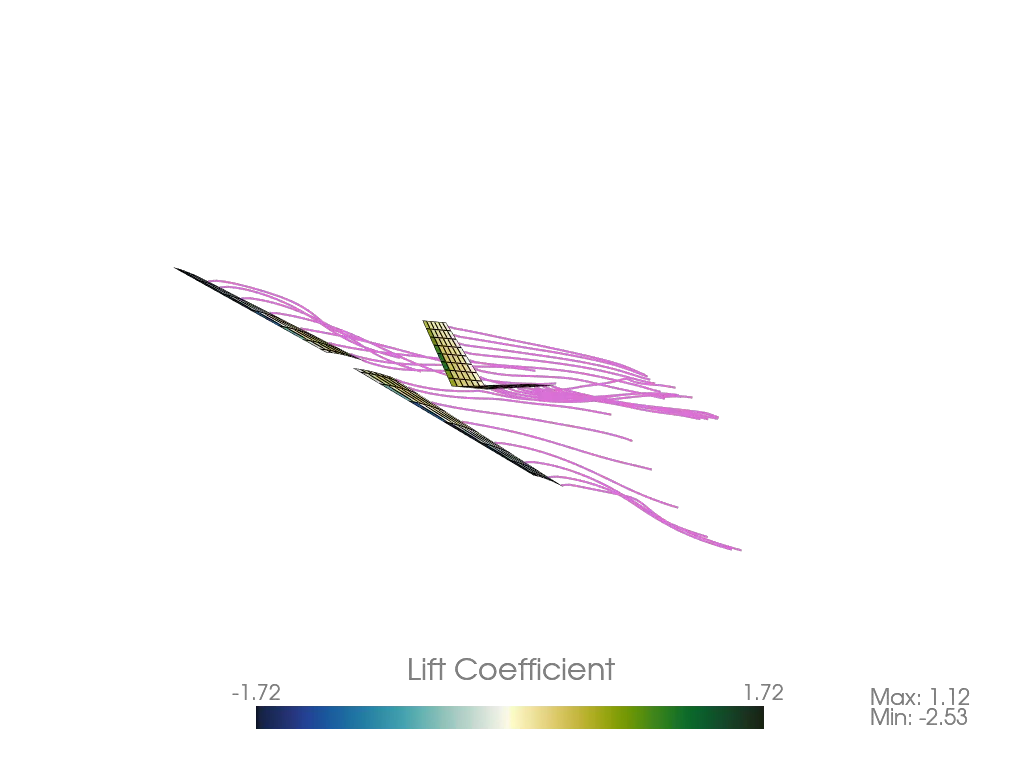
# Call the draw function on the loaded solver. For a free flight solver, the geometry is
# drawn in Earth axes at the final time step's true flight pose, so the airplane appears
# where and how it ended up after the final time step. Press any key to close the
# plotter after it draws the output.
ps.output.draw(
    solver=loaded_solver,
    scalar_type="lift",
    show_streamlines=True,
    show_wake_vortices=False,
    save=True,
)


# Call the animate function on the loaded solver. For a free flight solver, this flies
# the airplane through the scene along its computed trajectory, producing a GIF saved in
# the same directory as this script. Press any key, after orienting the view, to begin
# the animation.
ps.output.animate(
    unsteady_solver=loaded_solver,
    scalar_type="lift",
    show_wake_vortices=True,
    save=True,
)

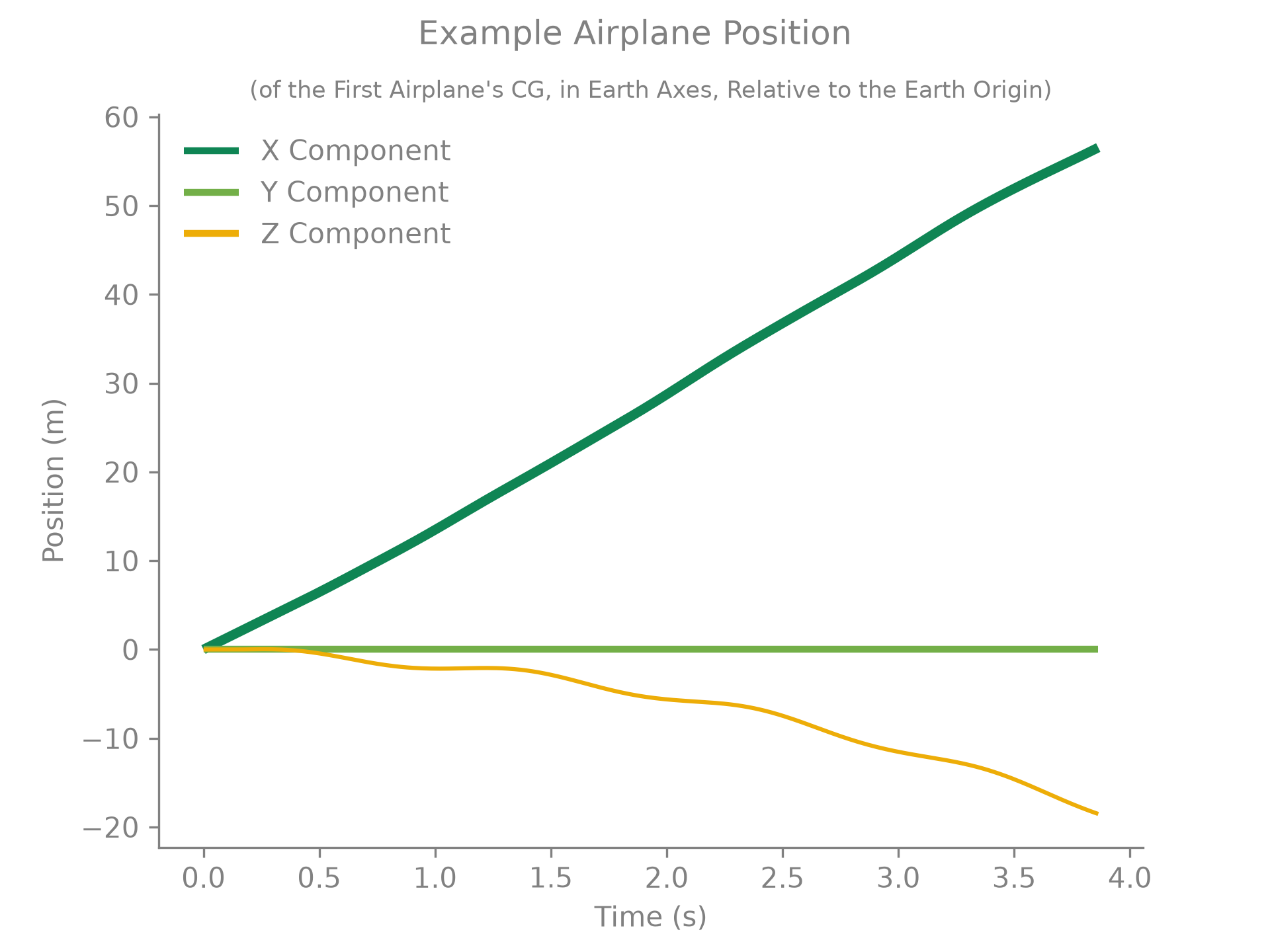
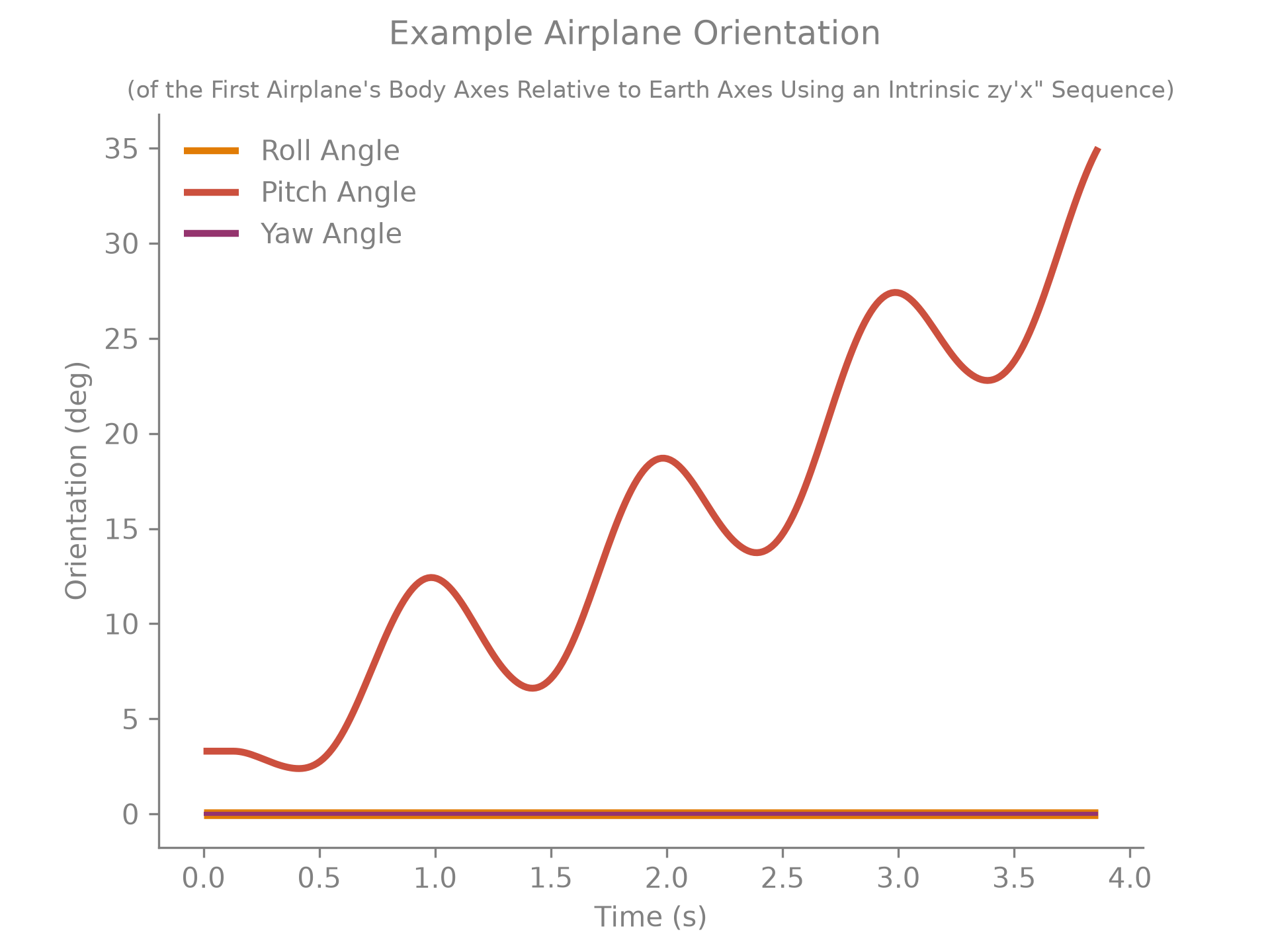
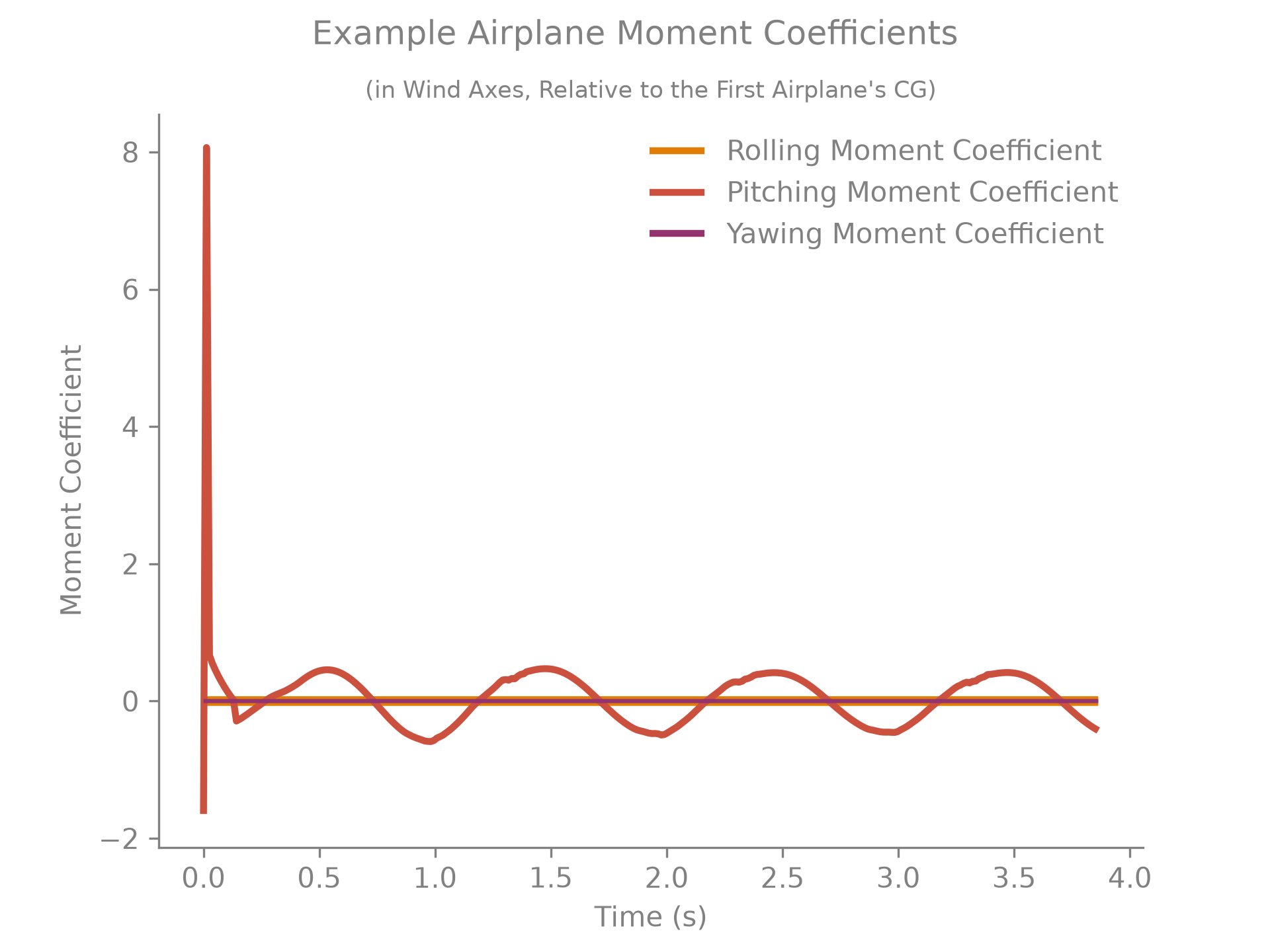
# Call the plotting function on the solver. This produces graphs of the loads with
# respect to time. For a free flight solver, it also plots the first Airplane's
# six-degree-of-freedom state history.
ps.output.plot_results_versus_time(
    unsteady_solver=loaded_solver,
    show=True,
    save=True,
)